 The muskox (Ovibos moschatus) is a hoofed mammal native to the Arctic. It is noted for its thick coat and for the strong odour emitted by males during the seasonal rut, from which its name derives. This musky odor has the effect of attracting females during mating season. Its Inuktitut name "umingmak" translates to "the bearded one". 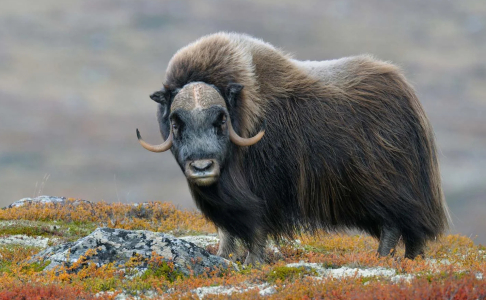 Muskoxen can be found in the Arctic areas of Northern Canada, Greenland, Norway, Siberia and Alaska. The muskox's typical habitat is tundra, the dry Arctic grassland. During the summer, muskoxen live in wet areas, such as river valleys, moving to higher elevations in the winter to avoid deep snow. Muskoxen will eat grasses, arctic willows, woody plants, lichens and mosses. When food is abundant, they prefer succulent and nutritious grasses. Willows are their main source of food in the winter.
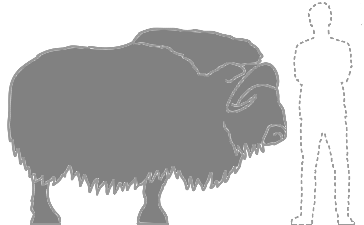 Both male and female muskoxen have long, curved horns. Muskoxen stand 1.1 to 1.5 m high at the shoulder. The small tail, often concealed under a layer of fur, measures only 10 cm long. Both male and female muskoxen have long, curved horns. Muskoxen stand 1.1 to 1.5 m high at the shoulder. The small tail, often concealed under a layer of fur, measures only 10 cm long. Their coat, a mix of black, gray and brown, includes long guard hairs that almost reach the ground. The thick coat of fur and its large head make the muskox appear larger than it really is; the bison, to which the muskox is often compared, can weigh up to twice as much. Muskox are heterothermic mammals, meaning they can shut off thermal regulation in some parts of their body, like their lower limbs. Maintaining the lower limbs at a cooler temperature than the rest of their body helps reduce the loss of body heat from their extremities. Muskoxen live in herds of 12–24 in the winter and 8–20 in the summer, when dominant bulls expel other males from the herd. They do not hold territories, but they do mark their trails with specialized glands. Muskox bulls assert their dominance in many different ways. One is a "rush and butt", in which a dominant bull rushes a subordinate from the side with its horns, and warns the subordinate so it can have a chance to get away. Bulls will also roar, swing their heads, and paw the ground. 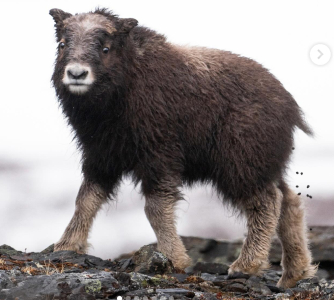 The herds move more often when cows are lactating, to let them get enough food to nurse their offspring. Cows have an eight- to nine-month gestation period, with calving occurring from April to June. Cows do not calve every year, often missing a year when winters are severe.
 Calves can keep up with the herd within just a few hours after birth. The calves are welcomed into the herd and nursed for the first two months. After that, a calf begins eating vegetation and nurses only occasionally. Cows communicate with their calves through braying. The calf's bond with its mother weakens after two years. Muskoxen are sometimes kept domestically for their wool, and occasionally for meat and milk. The U.S. state of Alaska, for example, has several muskoxen farms specifically aimed at wool harvesting. The wool, called qiviut, is highly prized for its softness, length, and insulation value. A muskox can reach speeds of up to 60 km/h. Their life expectancy is between 12 and 20 years. The primary predators of muskoxen are arctic wolves. Other occasional predators, likely only of calves or sick adults, can include grizzly bears and polar bears, as well as wolverines. If there are many predators, such as a pack of wolves, muskoxen form a defensive circle. Adults stand shoulder to shoulder facing the threat, with the young inside the circle. Both sexes have horns, which they point towards the threat. 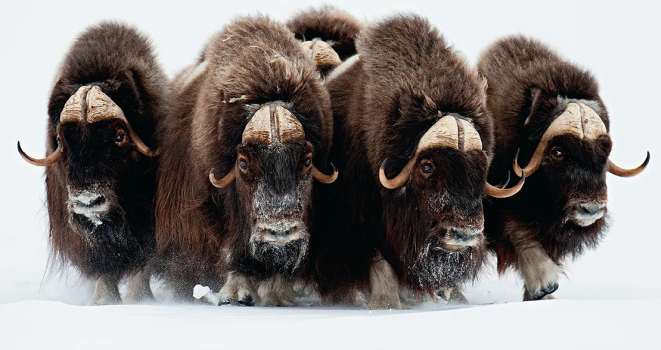 Muskoxen are not known to be aggressive. Fatal attacks are extremely rare, but humans who have come close and behaved aggressively have occasionally been attacked. Some information obtained from Wikipedia |