 The quokka is a macropod, in the family that includes kangaroos, wallabies, wallaroos, tree kangaroos, and more. They are about the size of a domestic cat, and they live in far western Australia, including several islands, especially Rottnest Island.  Because of their goofy 'smiles', quokkas have been called the 'world's happiest animal'. However, quokkas are not really smiling. This is simply the shape of the creature's mouth; the prominent front teeth often contribute to the illusion of a smile.
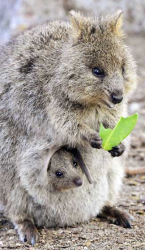
Weighing up to 5 kg and half a metre long, quokkas are nocturnal, and vegetarians. Quokkas have a stocky build, well developed hind legs, rounded ears, and a short, broad head. They primarily eat grasses, sedges, and leaves. Quokkas are marsupials, so the mothers keep their babies in a pouch. 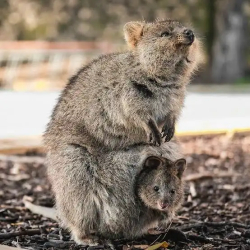 When running away from a predator, sometimes these babies fall out of the pouch. The mother may keep running, leaving the baby behind. This can also happen with other marsupials. The baby then distracts the predator by making a noise, allowing the mother to make an escape.
It's like when a lizard loses its tail, which wriggles around, distracting the predator, allowing the lizard to escape. With the quokka, if a predator catches the mother, it will kill both the mother and the baby. If the mother can escape by dropping the baby, she can have more babies. A harsh way to ensure survival of the species! But the mother will have several other babies in her womb in a suspended state of development, ready to develop if something bad happens to the baby that was already born. These embryos are back-ups, just in case! 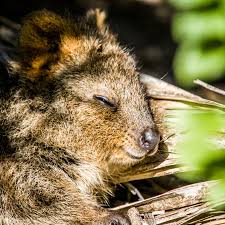 Looking like a small kangaroo, quokkas can climb small trees and shrubs up to 1.5 metres high. The quokka can live for an average of 10 years. The quokka spends the day sleeping in the thorny Acanthocarpus preissii plant, using the plants' spikes for protection and hiding.
Females can give birth twice a year and produce 17 joeys on average during their lifespan. Each lives in its mother's pouch for six months. Once it leaves the pouch, the joey relies on its mother for milk for two more months. Quokkas are marsupials, so the babies are born very small, the size of a jelly bean. The tiny joey climbs from the birth canal to the pouch using its hands, where it stays for about six months. 
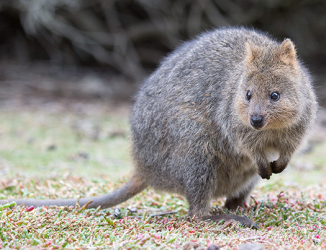
Quokkas have little fear of humans and commonly approach people closely, particularly on Rottnest Island, where they are abundant. Although quokkas are approachable, they bite! 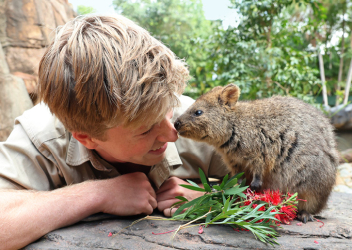
 |